Trump Signal Records Lawsuit: “Signalgate” and 2026 Legal Status
The Trump Signal records lawsuit—frequently referred to in the media as “Signalgate”—has become a central legal battleground regarding the Federal Records Act and the use of encrypted messaging by high-ranking government officials. As of March 2026, the case remains one of the most contentious pieces of litigation facing the current administration, raising critical questions about national security and democratic accountability.
The controversy began in March 2025 after a massive security breach revealed that top administration officials, including the Secretary of Defense and the CIA Director, were using the Signal messaging app to discuss sensitive military operations. The following article details the 2026 status of the lawsuit, the preservation orders currently in place, and the broader implications for government transparency.
The Origins of “Signalgate” (March 2025)
The lawsuit was triggered by a report in The Atlantic which revealed that National Security Advisor Michael Waltz had inadvertently added a journalist to a private Signal group chat. This chat contained real-time discussions regarding Operation Rough Rider, a series of U.S. airstrikes in Yemen aimed at Houthi rebels. The leak exposed that high-level decision-making was occurring on a platform designed for auto-deletion, which critics argue is a direct violation of the Federal Records Act (FRA).
The watchdog group American Oversight filed the initial lawsuit in late March 2025, seeking to stop the “unlawful destruction of federal records” and to compel the administration to recover any messages that had already been deleted via Signal’s disappearing message feature.
Current 2026 Legal Status: Preservation and Contempt
As of March 2026, the litigation is being overseen by U.S. District Judge James Boasberg. The case has reached several critical milestones over the past year:
- The Preservation Order: Judge Boasberg issued a preliminary injunction requiring the administration to “make best efforts” to preserve all Signal communications from the period of March 11–15, 2025. This order remains in effect as the court determines if these messages qualify as official federal records.
- Contempt Proceedings: Throughout late 2025 and into early 2026, the court has explored potential contempt charges against administration officials. Plaintiffs allege that despite the order, certain auto-delete settings were not disabled immediately, leading to the loss of potentially “classified” internal links and data.
- Forensic Investigation: A White House IT forensic audit confirmed that the journalist’s inclusion in the chat was a technical error (a mislabeled contact in a phone book). However, the legal focus has shifted from the “leak” to the “legality” of using such apps for government business in the first place.
The administration has argued that the President and his top advisors have a right to confidential communications and that the Federal Records Act does not strictly prohibit all forms of encrypted messaging. However, transparency advocates argue that using integrated design models that intentionally erase history undermines the public’s right to know.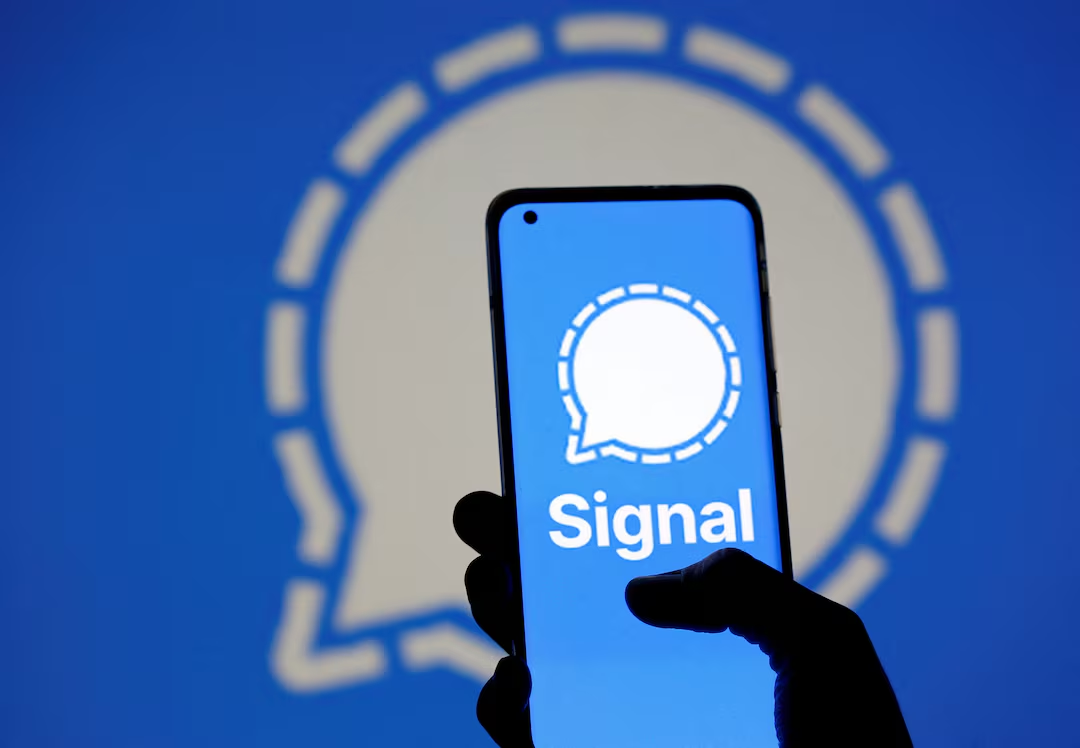
Key Officials Involved in the Lawsuit
The lawsuit names several prominent members of the administration who were allegedly part of the “Signalgate” group chat. These include:
| Official | Role | Legal Involvement |
|---|---|---|
| Pete Hegseth | Secretary of Defense | Primary defendant regarding military records. |
| John Ratcliffe | CIA Director | Questioned on intelligence sharing via Signal. |
| Tulsi Gabbard | Director of National Intelligence | Involved in the policy review of app usage. |
| Marco Rubio | Secretary of State | Named in the preservation order for diplomatic records. |
Implications for 2026 Policy and Beyond
The Trump Signal lawsuit has already forced a change in how the Pentagon and the White House handle mobile communications. In response to the litigation, a department-wide memo was issued in early 2026 clarifying that while third-party apps are permitted for “unclassified accountability,” they are strictly forbidden for processing or storing non-public unclassified information (CUI).
This case is being closely watched by legal experts as it could set a new standard for how the projected costs of government secrecy are balanced against the need for modern, secure communication tools. A final ruling on whether the auto-deleted messages must be “reconstructed” through forensic means is expected by mid-2026.
Conclusion
The Signalgate lawsuit represents a historic test of the Presidential Records Act in the age of end-to-end encryption. While the administration maintains that the use of Signal was a matter of operational security, the courts are increasingly signaling that transparency cannot be “auto-deleted.” Staying updated on these legal developments is vital for understanding how the next generation of government records will be managed and preserved.