
The Kate Merrill Lawsuit: Inside the $4 Million Discrimination Case Against WBZ-TV
For two decades, Kate Merrill (Katherine Merrill Dunham) was a staple of Boston morning television. As a lead anchor for WBZ-TV, an Emmy Award-winning journalist, and a trusted voice in New England, her sudden departure in 2024 left viewers and colleagues stunned. In late 2025 and moving into March 2026, the Kate Merrill Lawsuit has become a focal point of legal and media scrutiny, as the former anchor seeks $4 million in damages from WBZ, CBS, and Paramount Global, alleging she was the victim of race and gender-based discrimination.
The Catalyst: A Shift in Corporate Culture
According to the federal lawsuit filed in Boston, Merrill alleges that her career was derailed by a corporate push to meet Diversity, Equity, and Inclusion (DEI) quotas. The filing contends that WBZ-TV management prioritized “diversity targets” over merit and seniority, leading to a hostile work environment for Merrill. The suit cites internal remarks from CBS executives describing WBZ as “too white” and “the least diverse station” for on-air talent as the motivation behind the station’s subsequent actions against her.
The legal complaint details a specific incident in May 2024, where Merrill was demoted from her high-profile weekday morning slot to weekend nights. Merrill’s legal team argues that this was a “career-ending” move designed to humiliate her and force her resignation. This struggle over corporate accountability and the perceived manipulation of workplace data is a theme also found in the Amazon Class Action Lawsuit 2025, where algorithmic systems are alleged to disadvantage specific groups for corporate gain.
Allegations of “Microaggressions” and False Accusations
The Kate Merrill Lawsuit centers on her interactions with two newly hired Black colleagues, meteorologist Jason Mikell and anchor Courtney Cole. The station allegedly accused Merrill of committing “microaggressions” and displaying unconscious bias. Specific claims include:
- The “Find Your People” Comment: Merrill allegedly told Mikell he would “find his people” in Boston, which was interpreted as a racial comment. Merrill contends she was referring to finding a community of friends and colleagues in a new city.
- The Nashville Suggestion: Merrill suggested that Courtney Cole consider a move to Nashville for career advancement. The suit claims Cole interpreted this as a suggestion that Nashville would be a “better racial fit,” while Merrill maintains it was purely professional advice based on her own successful time in that market.
- The Weekend Query: Merrill was reportedly criticized for failing to ask a colleague about his weekend, which was cited as evidence of her bias.
Merrill denies all allegations of racism or bias, asserting that her actions were misconstrued to justify a predetermined DEI-driven agenda. This tension between literal communication and corporate interpretation is similar to the branding disputes in the ZOA Energy 0-preservatives settlement, where the intended meaning of a label was legally challenged by the practical function of its ingredients.
The Gazebo Incident and Management Failure
A significant portion of the lawsuit details a February 2024 on-air incident involving Jason Mikell. The complaint alleges that Mikell made an inappropriate sexual innuendo, implying that he and Merrill had sexual relations at a gazebo. Merrill claims that despite complaints from her executive producer and her own reports to HR, Mikell was not disciplined. The suit further alleges that when Merrill later attempted to correct Mikell’s on-air pronunciation of the word “Concord” via a private text, he responded with an aggressive verbal confrontation on the studio floor.
Merrill argues that management’s failure to investigate her complaints while simultaneously targeting her for “microaggressions” constitutes a double standard based on her race and gender. The administrative complexity of these internal investigations mirrors the legal hurdles seen in the Tesla Odometer Lawsuit, where the accuracy of reported “events” (mechanical or interpersonal) is at the heart of the litigation.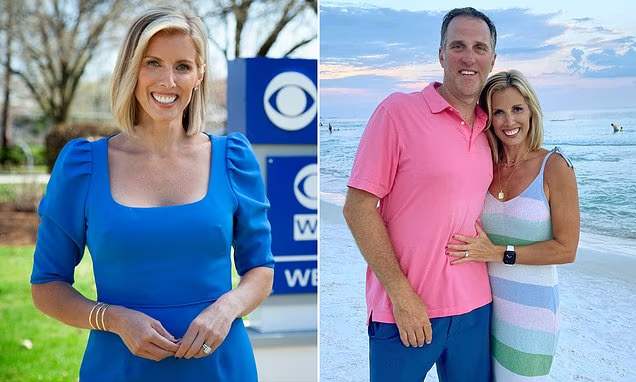
2026 Case Status: Constructive Discharge and Non-Competes
As of March 2026, the case is moving toward the trial phase in Massachusetts federal court. A major point of contention is Merrill’s “constructive discharge” resignation in May 2024. She argues that the demotion and the public manner in which it was announced (which she claims was “celebrated” by manager Justin Draper) left her with no choice but to leave. Furthermore, the suit challenges the non-compete clause in her contract that prevented her from working in the Boston market until June 2025, claiming it exacerbated her financial and professional damages.
Conclusion: A Landmark Case for Media Law
The Kate Merrill WBZ lawsuit is more than just a dispute over a news desk; it is a landmark case that tests the legal boundaries of DEI policies in the American workplace. Whether the court finds in favor of Merrill or the station, the verdict will likely influence how media organizations balance diversity initiatives with the rights of long-tenured employees. For viewers in Boston and beyond, it is a reminder that the faces they see on screen are often navigating a complex and sometimes contentious legal environment behind the scenes. As the 2026 proceedings continue, the outcome remains one of the most highly anticipated media law decisions of the year.